Showing posts with label shared drawings. Show all posts

Sunday, June 3, 2012

Contour drawing


"The essence of drawing is the line exploring space." ~ Andy Goldsworthy 

I hope you have had a chance to explore the idea of "right brain drawing." Did you try drawing the faces? Did you get the idea of drawing, not the recognizable object, but the lines and angles and shapes without thinking about what they are?

Contour drawing is a great way of getting into your right brain and really observing your subject. Contour drawing is drawing the outer lines of the object. As much as you can, you follow the contour of the outer edges of an object with your eyes, as your pencil follows along. Don't think that you are drawing a bowl or a roller skate or whatever, just think about where the line is going. Think about the shape it is taking, the ins and the outs and where it curves gently or turns a quick corner. Remember that poppy I drew last week? That was a contour drawing, with a few details added.

Pick an object with an interesting shape. A key is a good small object to start with. Nothing that is iconic or, if it is, try to put the stereotypical image aside while you draw.

Contour drawings tend not to be perfect or even as realistic as you may want, but they are so good for training your eye to really see, and I find they often have a lot of character and a certain charming quirkiness. Strive for a confident line, not a wimpy or sketchy line.

Pick a more complicated object and draw its contours. Don't worry too much about exact proportions or proper perspective. Let your eye just move around the outlines. Don't add any shading. This toy had some good lines.

I think if I did a small contour drawing every day for a year I would get good at it! Maybe that's a good goal.

Shares

Janet Burns drew a sunflower. I love the sense of movement in the petals.

Karen Miller did a sketchbook theme page of  a couple kinds of flowers. Then added color.

Jean Shute drew her foot and shoe. Nice value range in this drawing. It's good to see a black black, grays and white in a drawing.

This is Jean's geranium. Isn't this a nice technique? Not sure how Jean did it, but if I were doing this I would start with a very light pencil drawing, add the inked dots, then erase the pencil.


Jean says, "The flower drawing is certainly not a quick way to draw, but it can be somewhat meditative to sit tapping on the paper until it comes to life.  Also easy to camouflage a misplaced line. "

Saturday, June 2, 2012

Sorting out your brain for drawing

 
"An individual's ability to draw is... the ability to shift to a different-from-ordinary way of processing visual information – to shift from verbal, analytic processing to spatial, global processing. (Betty Edwards)"

My favorite book about drawing is Drawing on the Right Side of the Brain by Betty Edwards. If you really want to learn to draw the very best advice I can give you is to buy this book and use it.


I will be suggesting some of the exercises from this book, but you really need your own copy. You won't be sorry.

Dr. Edwards explains that the brain is divided into two sides that house different kinds of thinking processes. The left, most commonly accessed half of the brain is the analytical part, and also includes language. The right, less-used side of the brain is the intuitive side and also where the functions of space perception lie. Her theory is that in order to draw effectively you need to access that right half and suppress the left side functions—at least while you are drawing. You, of course, need to figure out how to access that part of your brain and how you will know when you are doing it! Here is an exercise she suggests to feel the difference between the two ways of thinking as you draw:

Begin by drawing a simple silhouette of a face on one side of your paper (left side for right handed people, right side for left-handers.)

This does not need to be beautiful or even terribly realistic, but as you draw think about what parts of the face you are drawing, naming them as you go—forehead, eyebrow, dip where the eye goes, nose, etc. etc. This is the left brain approach of using language and memory of what a face looks like.

Now move to the other side of the paper and draw a mirror image of the first silhouette. This time concentrate on the position of the line, the angle, how long that angle goes until it changes direction. You are not thinking of a face, only following the contour of the line. Now you are working in your right brain.

When you have finished both silhouettes you can connect them, if you like, to form a goblet or candlestick shape.

Try it again, adding more detail to the silhouette by making it a grotesque face, like a witches face. Again, as you draw the first silhouette, name the features as you move your pencil.

Then draw the mirror image again, concentrating on the shapes and angles only.

Could you sense a difference in the way you were creating the second drawing? This is a great exercise to continue to work on until you can really tell you have made a transition from one part of your brain to another.

Shares

Lisa Flowers Ross sent a lovely flower drawing.


Kristin La Flamme, in the moving process, says everything is packed up. She must now draw from memory.


Janet Burns drew a shoe. I think she has done this before!

Drawing is like handwriting. Everyone's style is unique.

Monday, May 28, 2012

Flowers and more shared drawings


"I have learned that what I have not drawn I have never really seen, and that when I start drawing an ordinary thing, I realize how extraordinary it is, sheer miracle. " ~Frederick Franck, The Zen of Seeing.

 My poppies started blooming this week and they are incredible! I am always surprised how much poppies of this kind actually look like they are made of paper. The petals have that crinkly paper look. I like drawing the complexity of flowers. Drawing them really challenges you to put aside your mental shortcut images of flowers and look carefully at the structure. This is a line drawing, without any shading. It is good practice for me at carefully observing the shapes and lines.

Karen Miller sent me some drawings and commented, "Hard edges are easier to draw than iris petals for example, because one can much more easily see the distortions there, so self correcting works better." Probably so, but I am happy to have the "fudge factor" that drawing a flower petal gives you. You can make a few mistakes in detail and proportion and nobody ever knows!

Karen drew her morning juice container from memory, then from life. I think her memory was quite good!


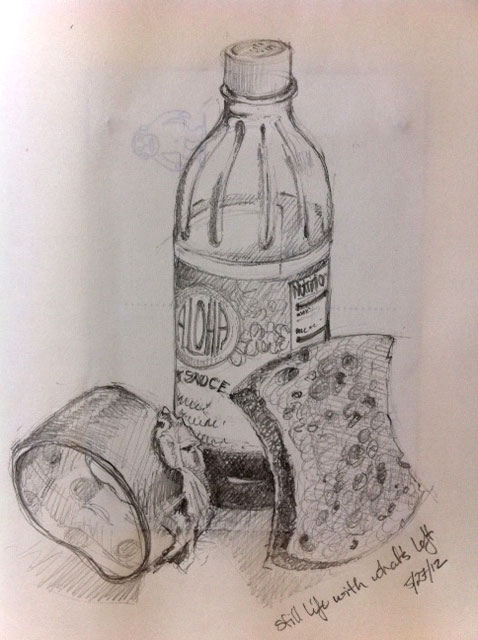
Kristin LaFlamme is in the process of packing  up her household for a cross country move. She said her still life was stuff left behind..

My sister-in-law, Jamie Grant, lives in Montana and is joining in with some drawings. She said she was "influenced" by the web site, Five Pencil Method.  You can take drawing lessons through the web site, but they also have some free tutorials that I plan to go back and look at. Thanks, Jamie. I will add it to the inspiration page.

Jamie drew her tea kettle from memory and then again from live observation.


Jamie's shoe. Lots of great detail.

Keep drawing!

Sunday, May 27, 2012

Thanks!

Thanks for the interest that so many of you have shown in this blog! Someone asked if I minded if they posted my little square graphic and a link to this blog on their blog. I would love it if people want to do that! Here is the graphic.

 Please link it back to this blog: http://penpencilpaperdraw.blogspot.com/

I also wanted to point out the tabs at the top of this page. The one called "tools" has some suggestions for drawing supplies and the one called "inspiration" will take you to websites and blogs about drawing, as well as suggesting some books and other resources. If you have suggestions for resources to add to this I will post them. The more, the better!

And now, I have some shoe drawings to share.

Kristin LaFlamme sent her drawing of her Hawaiian shoes


Karen Miller shared her sneaker drawing


Click on over to Quilterin's blog to see her wonderful red sandal drawing.

Thursday, May 24, 2012

Did you draw your shoe?

Did you know that Andy Warhol drew a whole series of shoe drawings? They are nothing like his soup cans!


vanGogh painted and drew many, many shoes.

I remember seeing this painting of his shoes in a museum in France and being very moved by it. Something about shoes. They take on the shape of the wearer's foot and are shaped by the wearer's gait and walking habits. More than other kinds of clothing, shoes conform to the wearer and become almost a part of you.

More vanGogh shoes:


These are the shoes I walked around Europe in back in 1972.

I drew them in a campground in Italy. I used a non-permanent Flair marker, then used a wet paintbrush to add a wash by picking up some of the ink from the drawing.

So, did you draw your shoe yet?