Showing posts with label contour drawing. Show all posts

Monday, July 16, 2012

Blind Contour Drawing

Kristen reminded me that blind contour drawing is really the best exercise for training your brain to see! She actually recommended negative space blind contour drawing, but that is a little bit like more than my brain can actually deal with, so for now I'm talking about blind contour drawing. Here's how you do it: set up some object to draw, then position yourself so that you have to turn your head away from your drawing pad to see the object. Here's my object.

Look at your pad and decide where you will begin drawing, then put the tip of your pencil or pen on the paper there, then do not look at your drawing again until you finish! Turn your eyes toward what you are drawing. Let your eyes move slowly around the object, and following your eyes with your pen on the paper, carefully drawing dips, curves, corner, details as you go. But remember, you are not looking at the paper—not even a little peek!

Now look at your drawing.


I guarantee it will be an odd-looking drawing. But the point of this is not to make a perfect drawing. The point is to train your eye and hand to work together. To shift into your right brain where you are seeing all the little dips and curves and translating the mass as it really looks, not as your short-cut brain thinks it looks. And then really look at your funny drawing. I think there is always something very truthful in these blind contour drawings. You get the proportions wrong for sure, but there is a spirit of the object that comes through and a nice sensitivity to the line.

Kristen has spent the past month moving from Hawaii to the East Coast, but sent me several drawings I posted earlier. Today I got this.


"Tada! My favorite mug is unpacked and in use. I see that I drew it less flared than in reality, and I remembered the text differently. Fun exercise though."

Friday, July 6, 2012

Shared drawings

I am home from a week-long road trip to Idaho, Wyoming and Montana. I took my drawing supplies along and did not take them out of the tote bag. I had good intentions, but too full a schedule, with obligations to other travelers to find the time. Sigh. That seems to be the way travel goes.

Thankfully, a couple of you had work to share!

Kristin LaFlamme sent these with her comments.


 "I tried drawing some flowers when you posted about yours on your drawing blog. Unfortunately, 
between the interruptions from the kids, the wind, and the fruity drinks (this was while we were at the hotel in Waikiki), I didn't finish either. ;-)"


 "I didn't find time to draw on our road trip. But, now that we are in our house with practically nothing, there is some time to stare at the ceiling. Here's a contour drawing (sometimes looking at the paper, sometimes not) of my view!"


 "Since the ceiling fan drawing sucked, I tried something a little more organic. Without going outside in the oppressive heat, our souvenir bota bags were the next best thing."

Karen Miller sent a couple of drawings done outdoors that she added watercolor to.


You can click on these to see them larger and read the writing.

" I decided to join a local outdoor art group for a trip to a local man's lovely Japanese garden. They go someplace different every Wednesday morning from May to October. I did two sketches there. Others were working in a variety of mediums, pastel, colored pencil, acrylics, watercolor. I am not up to painting woods and distant trees yet so I painted things closer to me. I have never included a person before but he was sitting so still I was able to draw him. They have a group critique at the end of the morning. I told them I was a rank beginner at watercolor, still at the sketchbook stage. Comments were that they wanted to see the rest of the sketchbook and I sure could draw for a beginner. I was pleased."

Thursday, June 21, 2012

Computers, Photoshop, Perfection and the Hand of the Maker

I have been told that drawing is dead because computers and cameras can provide all the images one would ever need! Well, first off that presumes that the only reason one would draw would be to create images. I hope you agree, or are at least are considering the idea, that drawing is as much about what the process is doing for our perceptions, our view of the world and our sense of  connection to all that surrounds us as it is to creating something we can frame and hang on the wall. But leaving that aside, let's just take a look at images—the product.

Photography is a fine way to create images. Here is a photo of the chair I drew the other day. I like the photo. By removing the background the graphic qualities of the chair are emphasized. This would be a good image to use if I were trying to sell the chair. It shows the style, the condition, the color and the shininess of the finish.

In Photoshop, I can apply filters to this photo to give it the look of a drawing—kind of.

Even a contour drawing.

I can even switch it up to emphasize the negative spaces.

As a graphic designer I have used these techniques extensively and I will be the first to tell you how much I love using Photoshop and Illustrator to create images.

But—

Even more, I love the look of a hand-drawn image because it is not perfect. It is not clean and perfectly proportioned. It is influenced by the hand of the maker, which is what gives all handmade work its soul and personality. Imperfect as it is, I think my little sketch of the chair is more interesting to look at and reflects something about my way of drawing; the choices I make; the parts I see well; the parts I don't see so well. Perfection may be overrated, in my opinion.

Am I wrong? What do you think?

Sunday, June 17, 2012

Contour drawing of a chair

I love drawing chairs. They are hard to draw. Lots of funny angles and fancy details. Then, of course, there is the matter of making the legs look like they are all sitting on the same floor. Here's today's drawing of my old bentwood chair. It came from the YWCA in Pocatello, Idaho. My mom was the executive director and bought it when they did some redecorating. She knew I loved it, and 40 years later I still do.

I have drawn this chair many times and I never get it right, but I think it is better each time. This time, at least, it seems to be sitting firmly on the floor. Don't look too closely at the seat. I started with a simple outline, then added some additional lines to indicate shading.

Then I tried the trick of drawing the negative space, lightly drawing, with pencil, an imaginary border around the negative space. I thought it might really emphasize the positive/negative aspects if I filled those negative spaces with a texture.. Those lines were very meditative and are purposely uneven and a bit wavery.


Thursday, June 14, 2012

positive and negative contour drawing

"The concept of  edges is a fundamental concept in art, having to do with unity, perhaps the most important principle in art. Unity is achieved when everything in a composition fits together as a coherent whole, each piece contributing to the wholeness of the total image."

-Betty Edwards, Drawing on the Right Side of the Brain

For me the practice of contour drawing—really focusing on those edges—is the most valuable drawing exercise I can do. Last night I went to my local guild meeting. The program was given by the wonderful Kerr Grabowsky and I was pleasantly surprised to hear her talk about how much she likes contour drawing and how valuable it is to her art.

One of the contour drawing exercises I really like and find challenging is identifying and drawing both the positive and negative spaces. Drawing negative spaces is a real right brain exercise if you can ignore the positive image and just focus on the shapes of the negative space.

Place an object or several objects on a contrasting background—a sheet of paper, a plain cover book, a place mat or napkin, etc. Be sure that your object(s) extend over the edge of the background in one or more places.

Start by drawing the object. Draw the contour, carefully observing the edges and the angles and the shapes, trying not to think of what object you are drawing, rather following the line of the contour with your eyes and observing it as line only.

Now, go back to your setup and look at the shapes of that background paper or book that your object is laying on. Try to make that little eye/brain flip that lets you see the individual shapes of the background, ignoring what is on top of it.
Observe that you have probably broken the background into more than one shape, by extending the foreground object over the edges. In my example I have three separate shapes to consider.

 Now draw those shapes, observing and following the edge, but this time not as the edge of the leaves and branch, but the edge of the negative spaces.


Shares

Jamie sent her contour drawing of several items, including the same key drawn from different angles.


There is a really nice loose, free feeling to these drawings! I especially like the keys, with their subtle hints of dimension. You can tell she was really feeling the shape of that key.

Wednesday, June 6, 2012

Contour drawing - irises

This is a great time of year for drawing flowers. I have some Japanese irises that Ray cut the other day and I worked on a contour drawing of a couple of them. Nice organic lines to follow. It becomes very meditative to just let your eye move slowly around each petal and notice how fluidly they blend into the stem.

It was tempting to "fix" that chewed leaf and simply extend it out into its natural point, but I pulled myself back into that space where things don't need names and lines are not leaves, but simply lines.

I like drawing with a permanent pen. For this I used a Pitt pen with a super fine point.

Don't be afraid to draw with a pen. You will love the crispness of the line. So, you can't erase if you make a mistake? Who's checking?

Sunday, June 3, 2012

Contour drawing


"The essence of drawing is the line exploring space." ~ Andy Goldsworthy 

I hope you have had a chance to explore the idea of "right brain drawing." Did you try drawing the faces? Did you get the idea of drawing, not the recognizable object, but the lines and angles and shapes without thinking about what they are?

Contour drawing is a great way of getting into your right brain and really observing your subject. Contour drawing is drawing the outer lines of the object. As much as you can, you follow the contour of the outer edges of an object with your eyes, as your pencil follows along. Don't think that you are drawing a bowl or a roller skate or whatever, just think about where the line is going. Think about the shape it is taking, the ins and the outs and where it curves gently or turns a quick corner. Remember that poppy I drew last week? That was a contour drawing, with a few details added.

Pick an object with an interesting shape. A key is a good small object to start with. Nothing that is iconic or, if it is, try to put the stereotypical image aside while you draw.

Contour drawings tend not to be perfect or even as realistic as you may want, but they are so good for training your eye to really see, and I find they often have a lot of character and a certain charming quirkiness. Strive for a confident line, not a wimpy or sketchy line.

Pick a more complicated object and draw its contours. Don't worry too much about exact proportions or proper perspective. Let your eye just move around the outlines. Don't add any shading. This toy had some good lines.

I think if I did a small contour drawing every day for a year I would get good at it! Maybe that's a good goal.

Shares

Janet Burns drew a sunflower. I love the sense of movement in the petals.

Karen Miller did a sketchbook theme page of  a couple kinds of flowers. Then added color.

Jean Shute drew her foot and shoe. Nice value range in this drawing. It's good to see a black black, grays and white in a drawing.

This is Jean's geranium. Isn't this a nice technique? Not sure how Jean did it, but if I were doing this I would start with a very light pencil drawing, add the inked dots, then erase the pencil.


Jean says, "The flower drawing is certainly not a quick way to draw, but it can be somewhat meditative to sit tapping on the paper until it comes to life.  Also easy to camouflage a misplaced line. "

Monday, May 28, 2012

Flowers and more shared drawings


"I have learned that what I have not drawn I have never really seen, and that when I start drawing an ordinary thing, I realize how extraordinary it is, sheer miracle. " ~Frederick Franck, The Zen of Seeing.

 My poppies started blooming this week and they are incredible! I am always surprised how much poppies of this kind actually look like they are made of paper. The petals have that crinkly paper look. I like drawing the complexity of flowers. Drawing them really challenges you to put aside your mental shortcut images of flowers and look carefully at the structure. This is a line drawing, without any shading. It is good practice for me at carefully observing the shapes and lines.

Karen Miller sent me some drawings and commented, "Hard edges are easier to draw than iris petals for example, because one can much more easily see the distortions there, so self correcting works better." Probably so, but I am happy to have the "fudge factor" that drawing a flower petal gives you. You can make a few mistakes in detail and proportion and nobody ever knows!

Karen drew her morning juice container from memory, then from life. I think her memory was quite good!


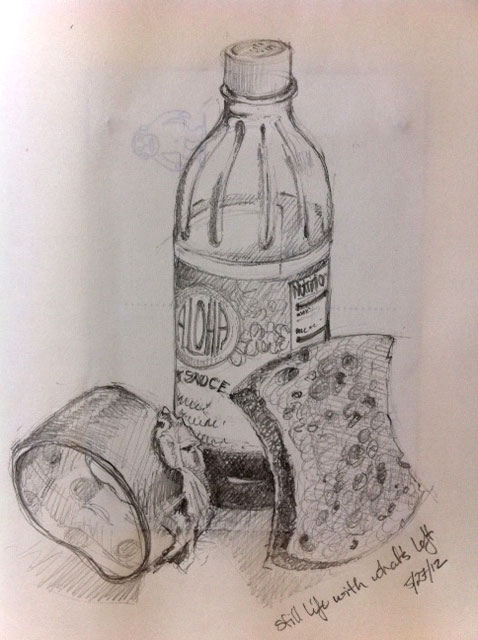
Kristin LaFlamme is in the process of packing  up her household for a cross country move. She said her still life was stuff left behind..

My sister-in-law, Jamie Grant, lives in Montana and is joining in with some drawings. She said she was "influenced" by the web site, Five Pencil Method.  You can take drawing lessons through the web site, but they also have some free tutorials that I plan to go back and look at. Thanks, Jamie. I will add it to the inspiration page.

Jamie drew her tea kettle from memory and then again from live observation.


Jamie's shoe. Lots of great detail.

Keep drawing!